Juhyun (Simon) Park

I am a second-year Ph.D. student in the Department of Computer Science at Princeton University. Previously I recevied M.S.E. in Computer Science (advised by Prof. Sanjeev Arora) and B.A. in Mathematics.
news
| 2026-10 | Do Theorem Provers Need Theorem-Proving Agents? mini-Lean-agent: A Coding-Agent Baseline for Lean will be presented at the NeurIPS 2026 MATH-AI Workshop. |
|---|---|
| 2026-09 | How does RL Post-training induce skill composition? A Case Study on Countdown is accepted at NeurIPS 2026 as a poster. |
selected publications
-
 Do Theorem Provers Need Theorem-Proving Agents? mini-Lean-agent: A Coding-Agent Baseline for LeanTomas Ortega, Simon Park, Ayush Khaitan, Liam Fowl, Alex Kontorovich, and 1 more authorMath-AI Workshop at NeurIPS 2026
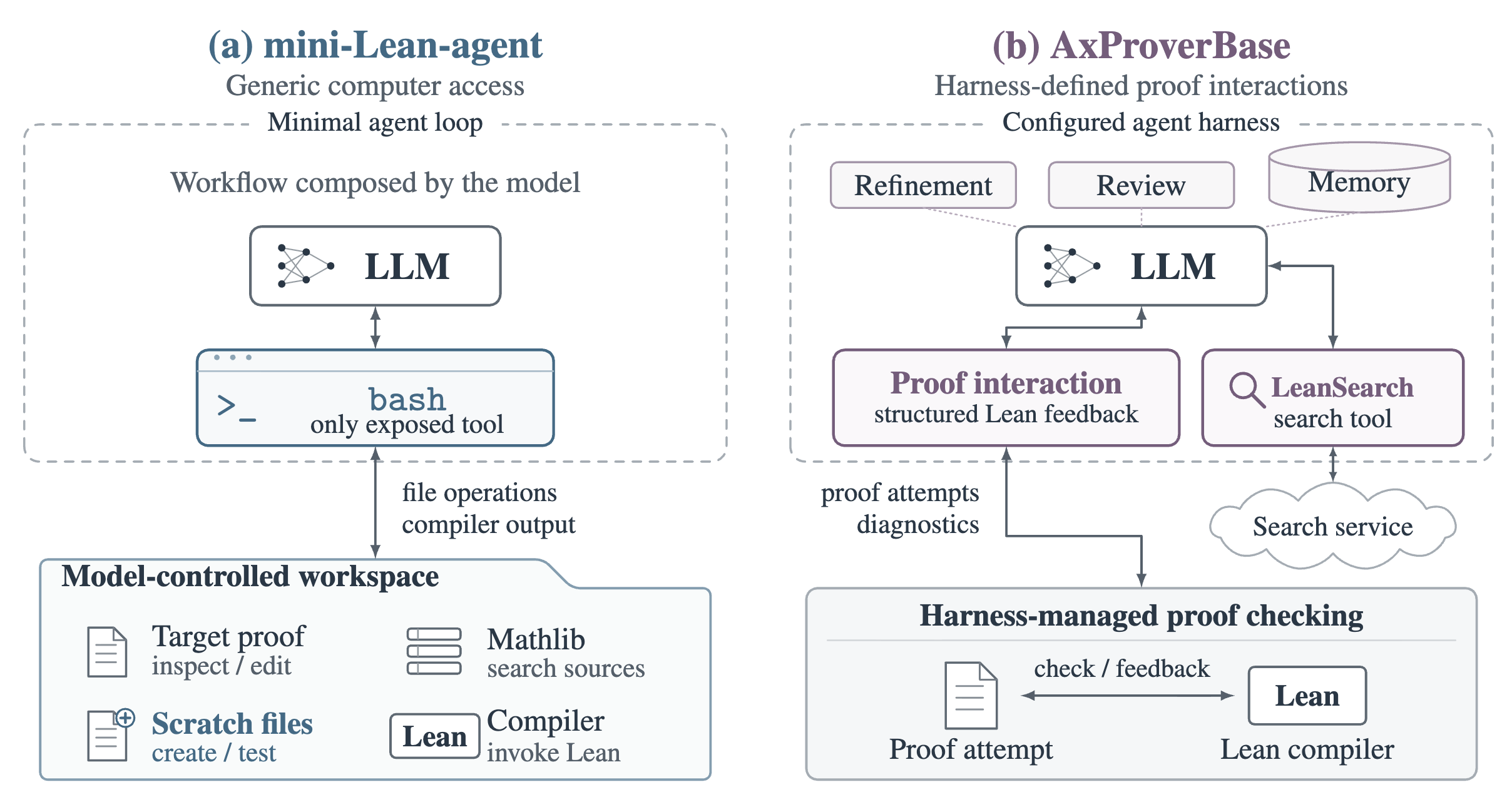
General-purpose coding agents use standard shell and file interactions, yet formal theorem-proving agents often rely on specialized, ad-hoc tooling. This makes it difficult to determine which components of theorem-proving agents provide benchmark gains: an improved base model, a specialized harness, a specific tool, or a combination of any of them. We introduce mini-Lean-agent, a deliberately minimal agent for Lean tasks whose only model-visible tool is bash. The model must use bash to inspect and edit the repository, search local libraries, invoke Lean, and manage its own intermediate work, while a separate trusted evaluator verifies the final artifact. We compare mini-Lean-agent against AxProverBase and Numina-Lean-Agent on the Putnam 2025 benchmark. Experiments with Gemini 3.8 Flash as the base model show that mini-Lean-agent solves 7/12 problems at 2 per problem limit, compared with AxProverBase’s 4/12. With Astra as the base model, mini-Lean-agent solves 12/12 problems at an average cost of 1.28 per problem. This suggests that a generic coding agent with a minimal harness can already achieve strong performance on Lean benchmarks. Our results motivate using mini-Lean-agent as a standard baseline when evaluating theorem-proving infrastructure.
-
 Goedel-Architect: Streamlining Formal Theorem Proving with Blueprint Generation and RefinementJui-Hui Chung, Ziyang Cai, Zihao Li, Qishuo Yin, Rohit Agarwal, and 12 more authorsAI for Math Workshop at ICML 2026
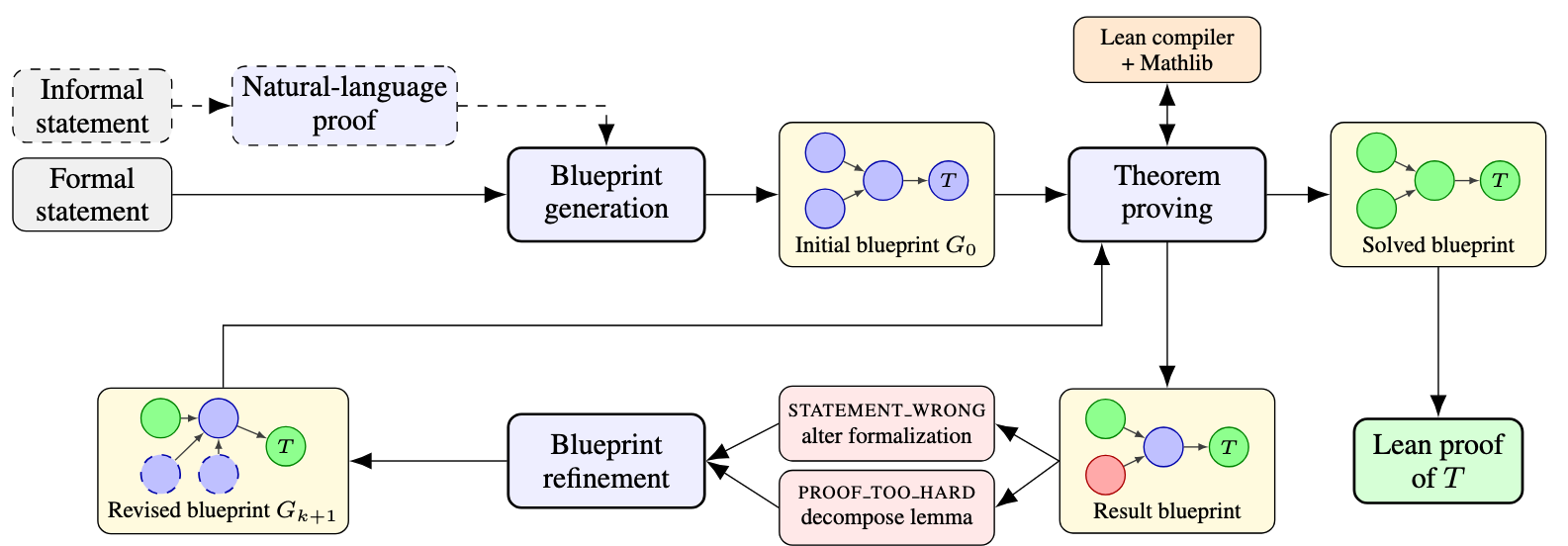
We introduce Goedel-Architect, an agentic framework for formal theorem proving in Lean 4 centered on blueprint generation and refinement. A blueprint is a dependency graph of definitions and lemmas that builds up to the main theorem. First, Goedel-Architect generates a blueprint of formally stated definitions and lemmas, along with declared dependencies. This blueprint is optionally guided by a natural language proof. Then, a tool-equipped Lean prover component closes each open lemma node in parallel using relevant dependencies. Failed lemmas in turn drive refinement of the global blueprint. This strategy contrasts with other mainstream approaches which use recursive lemma decomposition, and can inefficiently loop on dead-end strategies. Using the open-weight DeepSeek-V4-Flash (284B-A13B) as the backbone, Goedel-Architect attains 99.2% pass@1 on MiniF2F-test and 75.6% pass@1 on PutnamBench. With an optional natural-language proof seeding the initial blueprint on the harder problems, we additionally close the remaining two MiniF2F-test problems (reaching 100%), lift PutnamBench to 88.8% (597/672), and solve 4/6 on IMO 2025, 11/12 on Putnam 2025, and 3/6 on USAMO 2026. This represents state-of-the-art performance for an open-source pipeline at a price point up to 500x less than comparable open-source pipelines.
-
 How Does RL Post-training Induce Skill Composition? A Case Study on CountdownSimon Park*, Simran Kaur*, and Sanjeev AroraNeurIPS 2026
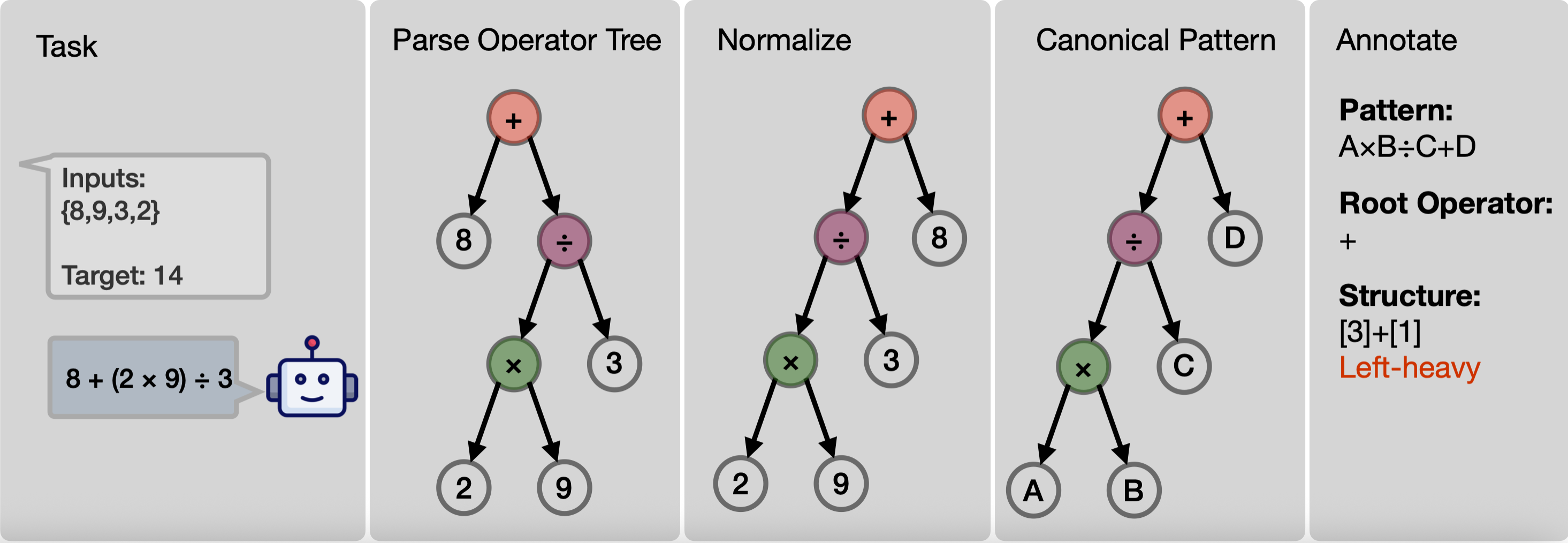
While reinforcement learning (RL) successfully enhances reasoning in large language models, its role in fostering compositional generalization (the ability to synthesize novel skills from known components) is often conflated with mere length generalization. To this end, we study what RL post-training teaches models about skill composition and how the composition structure affects the skill transfer. We focus on the Countdown task (given n numbers and a target, form an expression that evaluates to the target) and analyze model solutions using expression trees, where each subtree corresponds to a reusable subtask and thus can be viewed as a “skill.” Tracking tree shapes and their success rates over training, we find: (i) out-of-distribution (OOD) generalization to larger n and to unseen tree shapes, indicating compositional reuse of subtasks; (ii) the order of skill acquisition depends upon the composition structure—models master shallow balanced trees (workload is balanced between subtasks) before deep unbalanced ones, with persistent fragility on right-heavy structures for a fixed composition depth. Our diagnostic reveals what is learned, in what order, and where generalization fails, clarifying how RL-only post-training induces OOD generalization beyond what standard metrics such as pass@k reveal. To study the implication of our findings for more real-world tasks, we present a preliminary study on formal theorem proving.
-
 Generalizing from SIMPLE to HARD Visual Reasoning: Can We Mitigate Modality Imbalance in VLMs?Simon Park*, Abhishek Panigrahi*, Yun Cheng*, Dingli Yu, Anirudh Goyal, and 1 more authorICML 2025
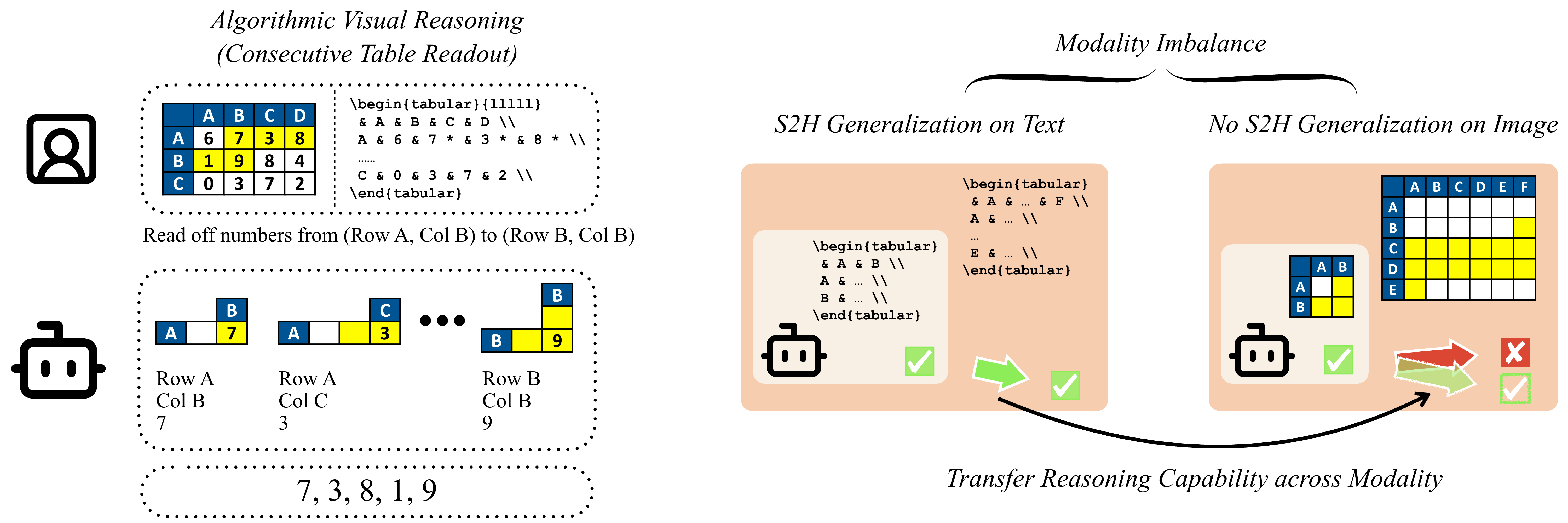
While Vision Language Models (VLMs) are impressive in tasks such as visual question answering (VQA) and image captioning, their ability to apply multi-step reasoning to images has lagged, giving rise to perceptions of modality imbalance or brittleness. Towards systematic study of such issues, we introduce a synthetic framework for assessing the ability of VLMs to perform algorithmic visual reasoning (AVR), comprising three tasks: Table Readout, Grid Navigation, and Visual Analogy. Each has two levels of difficulty, SIMPLE and HARD, and even the SIMPLE versions are difficult for frontier VLMs. We seek strategies for training on the SIMPLE version of the tasks that improve performance on the corresponding HARD task, i.e., S2H generalization. This synthetic framework, where each task also has a text-only version, allows a quantification of the modality imbalance, and how it is impacted by training strategy. Ablations highlight the importance of explicit image-to-text conversion in promoting S2H generalization when using auto-regressive training. We also report results of mechanistic study of this phenomenon, including a measure of gradient alignment that seems to identify training strategies that promote better S2H generalization.
-
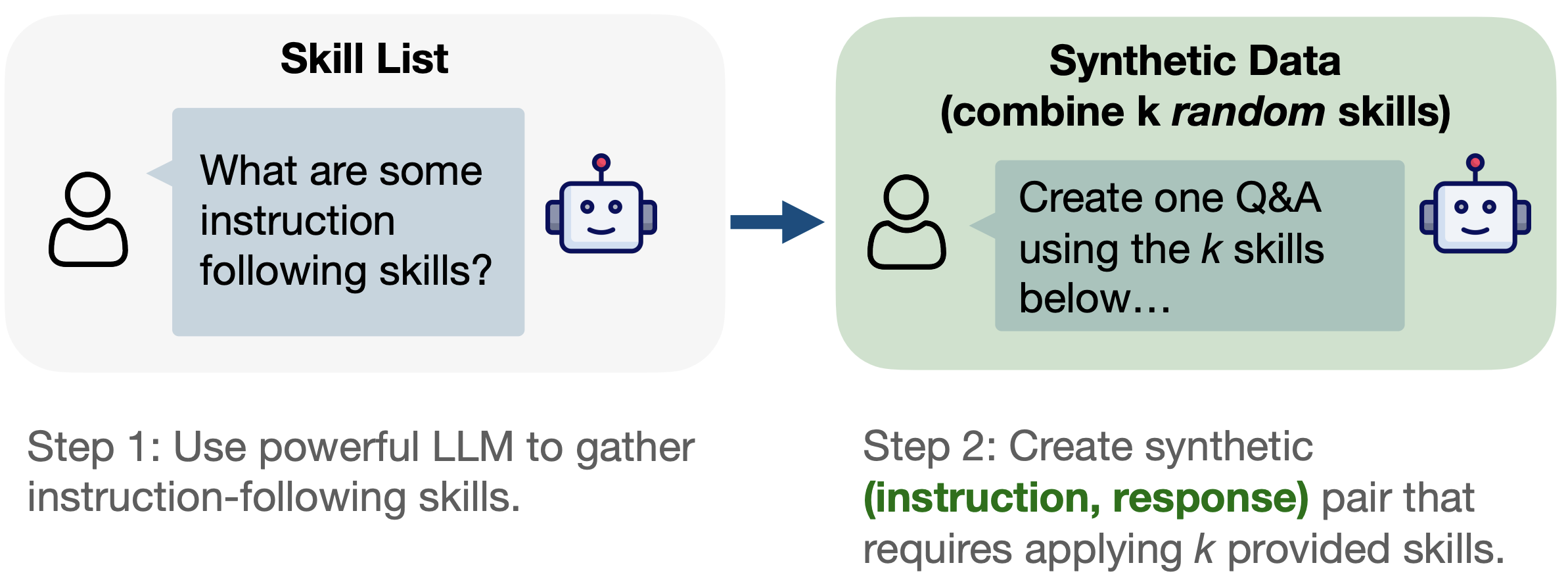 Instruct-SkillMix: A Powerful Pipeline for LLM Instruction TuningSimran Kaur*, Simon Park*, Anirudh Goyal, and Sanjeev AroraICLR 2025
We introduce Instruct-SkillMix, an automated approach for creating diverse, high quality SFT data. The Instruct-SkillMix pipeline involves two stages, each leveraging an existing powerful LLM: (1) Skill extraction: uses the LLM to extract core "skills" for instruction-following, either from existing datasets, or by directly prompting the model; (2) Data generation: uses the powerful LLM to generate (instruction, response) data that exhibit a randomly chosen pair of these skills. Here, the use of random skill combinations promotes diversity and difficulty. Vanilla SFT (i.e., no PPO, DPO, or RL methods) on data generated from Instruct-SkillMix leads to strong gains on instruction following benchmarks such as AlpacaEval 2.0, MT-Bench, and WildBench. With just 4K examples, LLaMA-3-8B-Base achieves 42.76% length-controlled win rate on AlpacaEval 2.0. To our knowledge, this achieves state-of-the-art performance among all models that have only undergone SFT (no RL methods) and competes with proprietary models such as Claude 3 Opus and LLaMA-3.1-405B-Instruct. Ablation studies also suggest plausible reasons for why creating open instruction-tuning datasets via naive crowd-sourcing has proved difficult. Introducing low quality answers ("shirkers") in 20% of Instruct-SkillMix examples causes performance to plummet, sometimes catastrophically. The Instruct-SkillMix pipeline is flexible and is adaptable to other settings.
-
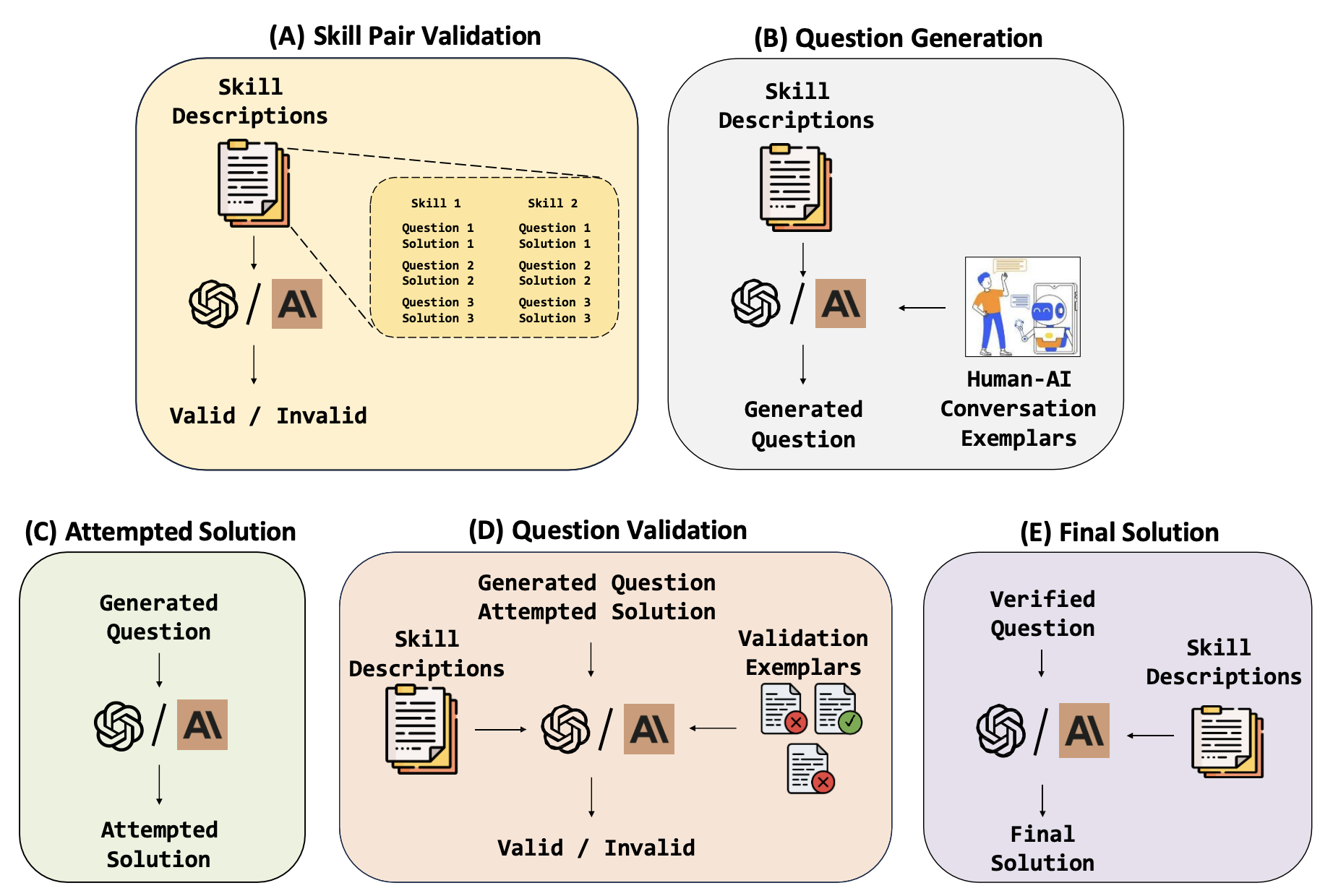 AI-Assisted Generation of Difficult Math QuestionsVedant Shah, Dingli Yu, Kaifeng Lyu, Simon Park, Jiatong Yu, and 6 more authorsMath-AI Workshop at NeurIPS 2024
Current LLM training positions mathematical reasoning as a core capability. With publicly available sources fully tapped, there is unmet demand for diverse and challenging math questions. Relying solely on human experts is both time-consuming and costly, while LLM-generated questions often lack the requisite diversity and difficulty. We present a design framework that combines the strengths of LLMs with a human-in-the-loop approach to generate a diverse array of challenging math questions. We leverage LLM metacognition skills [Didolkar et al., 2024] of a strong LLM to extract core "skills" from existing math datasets. These skills serve as the basis for generating novel and difficult questions by prompting the LLM with random pairs of core skills. The use of two different skills within each question makes finding such questions an "out of distribution" task for both LLMs and humans. Our pipeline employs LLMs to iteratively generate and refine questions and solutions through multiturn prompting. Human annotators then verify and further refine the questions, with their efficiency enhanced via further LLM interactions. Applying this pipeline on skills extracted from the MATH dataset [Hendrycks et al., 2021] resulted in MATH2 - a dataset of higher-quality math questions, as evidenced by: (a) Lower performance of all models on MATH2 than on MATH (b) Higher performance on MATH when using MATH2 questions as in-context examples. Although focused on mathematics, our methodology seems applicable to other domains requiring structured reasoning, and potentially as a component of scalable oversight. Also of interest is a striking relationship observed between models’ performance on the new dataset: the success rate on MATH2 is the square on MATH, suggesting that successfully solving the question in MATH2 requires a nontrivial combination of two distinct math skills.